Meltwater vs PRWeb: Pros & Cons, Costs, Alternatives
8 min read
Key Takeaways
Meltwater is built around monitoring media coverage and social conversations, with press release distribution bundled into its media relations module, while PRWeb sells nothing but distribution of individual releases.
Meltwater’s Starter, Pro, Enterprise, and Agency plans are custom-quoted, with published starting ranges from about $10,000 a year and contracts that usually run 12 months. PRWeb charges $120 to $480 per release with no subscription.
Meltwater’s strength is all-in-one monitoring, but it comes with annual contracts and no content creation. PRWeb is simple and predictable per release, but it gets costly at higher volume and only produces one written release.
Common alternatives include AmpiFire for multi-format, multi-channel content distribution and Muck Rack for journalist relationships.
AmpiFire turns one topic your customers are actively searching for into 8 content formats, automatically published across 300+ news, video, podcast, and social platforms, so it keeps working long after launch day.
Meltwater and PRWeb Solve Completely Different PR Problems
Meltwater and PRWeb solve different problems: one centers on monitoring media and social conversations and includes press distribution as one module among many; the other distributes a single press release to outlets and search engines. Teams often treat them as competing options, but they serve different jobs. A common mistake brands make when comparing the two is confusing monitoring software with a distribution service.
Getting this wrong has a cost. A 12-month Meltwater contract is scoped around monitoring and reporting, not ongoing content production, and a single PRWeb release stops generating fresh attention once the news cycle moves on. The real decision is whether the goal is tracking coverage or sustaining reach after one announcement.
For brands needing a release to keep driving traffic beyond the first week, AmpiFire turns one topic into a multi-format content campaign distributed across hundreds of platforms, covering ground neither Meltwater nor PRWeb handles alone.
Stop Limiting Yourself to Just PR or SEO
Multi-Channel Content Marketing Gets Real Results
The Problem: Traditional PR and SEO reach audiences through a single channel. Your customers are scattered across search, social media, video platforms, and podcasts.
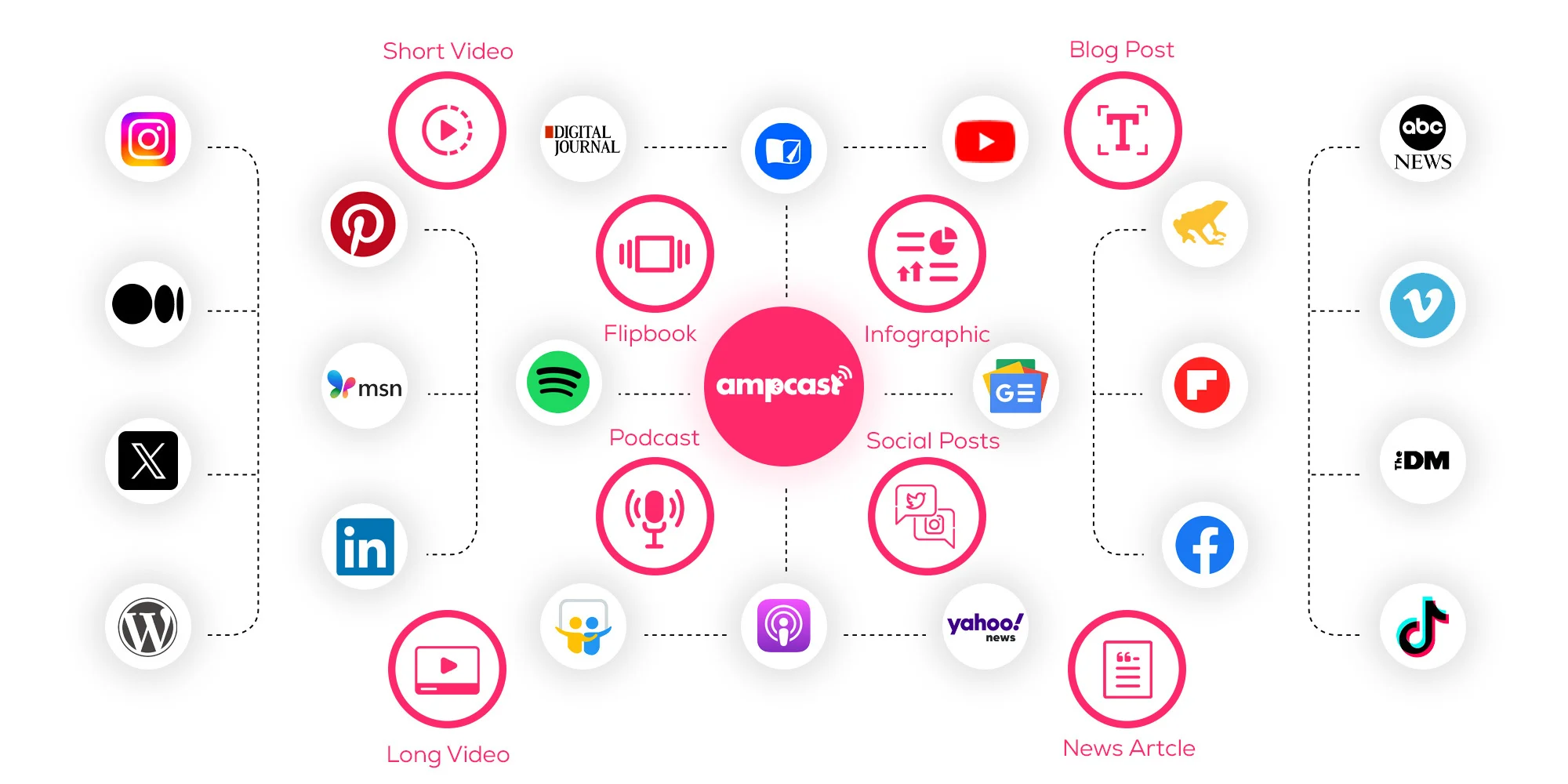
The Solution: AmpiFire’s AmpCast AI transforms a single topic into 8 formats (news articles, blog posts, interview podcasts, longer informational videos, reels/shorts, infographics, flipbooks/slideshows, and social posts) and automatically distributes them across 300+ high-authority sites, including Fox affiliates, Spotify, and YouTube.
What You’ll Discover on AmpiFire:
✓Why multi-channel content outperforms traditional PR and SEO
✓Real case studies of businesses dominating multiple platforms
✓Step-by-step guides for multi-format content creation
✓Cost-effective alternative to expensive agencies
✓Flexible content service options: from DIY software to a fully managed, done-for-you strategy
Meltwater is an all-in-one platform that PR, communications, and marketing teams use to track what’s being said about their brand. It pulls media coverage, social media conversations, and AI visibility data (how a brand shows up in answers from AI tools like ChatGPT) into one dashboard.
That makes it strongest for organizations whose main need is monitoring and reporting. Press release distribution is included in its media relations module, but it isn’t the core of the product.
Meltwater brings media monitoring, social listening, and AI visibility tracking into one dashboard. (Image source: Meltwater)
What Is PRWeb Used For?
PRWeb, part of Cision, is an online press release distribution service. It is built for businesses that want to send a single release to search engines, social media, partner sites, bloggers, and influencers. Unlike Meltwater, it is not a monitoring platform and does not track ongoing media conversations.
Cost Comparison
Meltwater Plans & Pricing
Meltwater does not publish a fixed price list, but it now shares indicative annual starting ranges of $10,000 for Starter, $25,000 for Pro, and $130,000 for Enterprise. Each quote still depends on the modules selected, data volume, number of users, integrations, and support level, and most contracts run for 12 months.
Meltwater offers four plans:
Starter: For small teams and startups. It includes media intelligence, social listening, AI visibility tracking, media relations, Mira AI, and pre-built dashboards.
Pro: For regional and multi-channel teams. It adds Advanced Mira AI, competitive benchmarking, and custom dashboards.
Enterprise: For global brands. It adds influencer marketing, Enterprise-grade Mira AI, API and MCP integrations (connections that let Meltwater data flow into other software and AI assistants), and governance controls (admin settings for who can view and change what).
Agency: For firms managing multiple clients. It adds influencer marketing, Advanced Mira AI, API and MCP integrations, and multi-client workflow controls.
PRWeb Plans & Pricing
PRWeb charges per release, with no recurring subscription. Every plan includes unlimited media assets and keyword tagging by the editorial team. The tiers differ in turnaround speed, syndication reach, and editorial support.
PRWeb offers four plans:
Basic ($120): For businesses that want a release online without extras. It has a 48-hour turnaround and does not include syndication to PR Newswire’s network.
Standard ($245): Adds syndication through PR Newswire, meaning the release is automatically republished on 1,200+ partner websites. Turnaround stays at 48 hours.
Advanced ($360): Adds editorial proofreading and email distribution to one industry-specific journalist list. Turnaround drops to 24 hours.
Premium ($480): Adds placement on Sovrn’s content-recommendation network (the “recommended stories” sections on publisher websites) and connections with influential bloggers, with a 24-hour turnaround.
PRWeb, part of Cision, charges per release and has no ongoing subscription. (Image source: PRWeb)
Differences in Pros & Cons
Meltwater Pros & Cons
Meltwater’s strengths and weaknesses both come from its core design. It was built to monitor and analyze, not to create and distribute.
Pros
One dashboard for monitoring. Media coverage, social sentiment, and AI visibility signals sit in one place, so teams don’t need to piece together separate monitoring tools.
Help for small teams. Mira AI filters noise and writes summaries, so small teams can keep up with coverage volume that would otherwise require more staff.
24/7 support. Help is available through live chat, email, the Help Center, Meltwater Academy, and the mCommunity user network.
Cons
No multi-format content creation. Meltwater supports monitoring, analysis, outreach, and press release distribution, but it does not create blog posts, videos, podcasts, or social content for distribution across other platforms. A brand that needs more than a wire release still needs separate content tools.
Pricing friction for smaller teams. There is no free trial, most contracts run 12 months, and pricing depends on modules, data volume, and integrations.
Extra upfront costs. Enterprise or complex setups may carry a one-time onboarding fee on top of the annual contract.
PRWeb Pros & Cons
PRWeb’s appeal is its simplicity: pick a tier, pay once, and the release goes out. That same simplicity becomes a limitation once a business needs more than a single distribution event.
Pros
Predictable costs. Businesses know the exact price before a release goes out, from $120 to $480, with no custom quote or annual contract.
Good fit for occasional releases. A company sending one or two releases a year pays only when it has news to share.
Built-in reach from Standard upward. Standard and higher plans add syndication to more than 1,200 sites through PR Newswire.
Cons
Costly at higher volume. The per-release model adds up quickly for businesses that publish regularly, since there is no bundled discount.
Release-only output. PRWeb distributes the written release but does not turn it into videos, podcasts, infographics, slideshows, or social posts. Any repurposing needs separate tools or teams.
Limited Basic plan. The cheapest tier skips the 1,200+ site syndication network, so businesses must move up to Standard for the reach most people expect from PRWeb.
What Do The Customers Say?
Meltwater Reviews
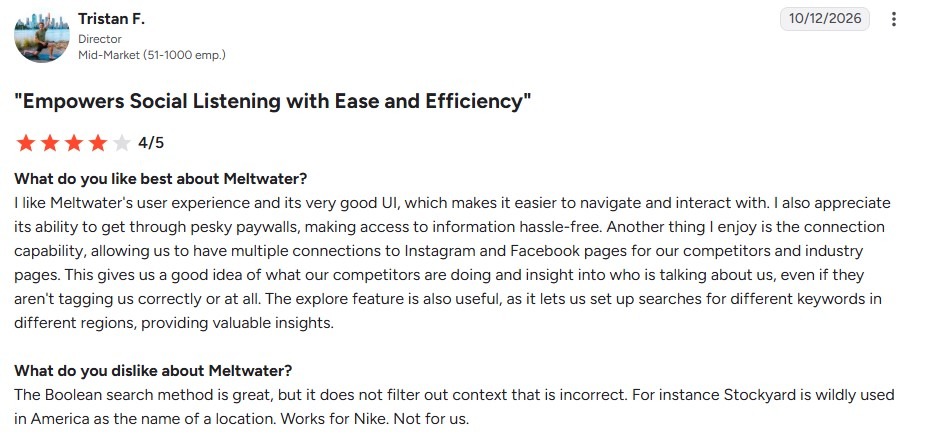
As of November 2026, Meltwater holds a 4.1 out of 5 rating on G2.
Users find the platform easy to use and value its access to paywalled content, competitor tracking, brand mentions where the company isn’t tagged, and regional keyword searches. The main drawback is search accuracy for brands with generic names, since searches can pull in many unrelated mentions.
Meltwater offers an easy interface and broad social listening, though keyword searches for generic brand names can return unrelated mentions. (Image source: G2).
PRWeb Reviews
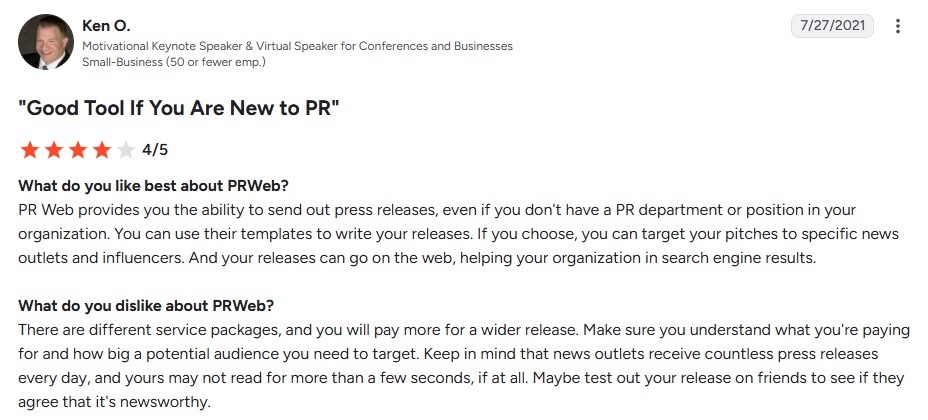
As of November 2026, PRWeb holds a 3.8 out of 5 rating on G2.
Users value that PRWeb lets organizations send press releases without a PR team, using built-in templates, outlet and influencer targeting, and placement in search results. The main drawbacks are cost, since wider distribution requires pricier packages, and crowded inboxes, which means releases may get little attention unless the story is clearly newsworthy.
PRWeb helps organizations without a PR team send releases using templates and targeting, though wider distribution costs more. (Image source: G2)
What Are the Best Alternatives to Meltwater and PRWeb?
1. AmpiFire for Multi-Format, Multi-Channel Content Distribution
AmpCast AI turns one topic into 8 content formats and shares them across news, video, podcast, and social platforms. (Image source: AmpiFire)
AmpiFire is built for businesses that need more than a single announcement that fades after a week. It turns one topic into 8 content formats: news articles, blog posts, interview podcasts, longer informational videos, reels/shorts, infographics, flipbooks/slideshows, and social posts.
It then distributes this content across 300+ high-authority sites, including Fox affiliate sites, Spotify, Apple Music, YouTube, and Pinterest, plus the business’s own social profiles like Instagram and X/Twitter.
The process runs in 3 steps:
Research the high-demand topics and questions customers search for before they buy, across Google, YouTube, Facebook, and other social platforms.
Turn one topic into 8 content formats.
Automatically distribute the content across 300+ news, social, video, podcast, image, and document-sharing platforms.
Pricing depends on how much of the process a business wants handled:
DIY Content Creation With AI (AmpCast): from $97
Done-for-You Optimized Multi-Format Creation: $297 to $2,497 per month
Completely Managed Strategy: from $3,600 per month, depending on volume
Today’s buyers move between Google, YouTube, podcasts, and social feeds before they decide, and covering all of them by hand would take a full content team.
AmpCast AI does most of that research, writing, and production work, which makes multi-channel content affordable for small businesses that couldn’t otherwise justify an in-house team or an agency retainer.
Because every campaign adds new content that stays online, results tend to build the longer a business keeps publishing.
2. Muck Rack for Journalist Relationships
Muck Rack helps PR teams find journalists, personalize pitches, and track earned coverage. (Image source: Muck Rack).
Muck Rack is PR software for finding journalists and content creators, monitoring media coverage, personalizing pitches, and tracking engagement. It covers digital, broadcast, print, podcast, newsletter, and social media channels.
Muck Rack offers three plans, with prices given by custom quote.
Starter: For solo practitioners and small businesses.
Standard: Adds unlimited media list exports and AI-powered journalist recommendations to the Starter features.
Premier: Builds on Standard with the platform’s full feature set.
Muck Rack suits PR teams focused on media relations and reporting on unpaid press coverage, rather than content creation or mass distribution.
Meltwater vs PRWeb vs Alternatives: Pricing and Features
Tool
Best For
Pricing
Content Output
Reach
AmpiFire
Ongoing multi-channel traffic from one topic
From $97
8 formats per topic
300+ high-authority sites
Meltwater
Media monitoring
Custom quote, from about $10,000/year
Press releases (via media relations module)
Monitoring plus release distribution
PRWeb
Single press releases
$120 to $480 per release
One release
1,200+ sites (Standard and above)
Muck Rack
Journalist outreach
Custom quote
None
Journalist database and outreach
Keep Your News Working After Launch Day with AmpiFire
Meltwater and Muck Rack focus on tracking coverage and supporting media outreach; Meltwater also offers wire distribution, while PRWeb sends a single release to news sites and media outlets. The right choice comes down to one question: does your goal end when the release goes out, or does it need to keep bringing in visitors for months afterward?
AmpiFire’s AmpCast AI is built for businesses that need the second option. Instead of one announcement that fades within a week, your brand shows up wherever buyers are looking: in search results, on YouTube, in podcast apps, and across social feeds. Because AI handles most of the research, writing, and publishing, you get that presence for a fraction of what an in-house content team or agency would cost, and each campaign adds to the traffic the previous one started. Browse AmpiFire’s plans to turn the next announcement into lasting traffic.
Frequently Asked Questions (FAQs)
Is Meltwater worth it for small PR teams?
Meltwater’s Starter plan is built for small teams, startups, and scale-ups with limited analytics needs. It includes media intelligence, social listening, AI visibility tracking, media relations, and Mira AI. However, pricing is custom-quoted, with published ranges starting from about $10,000 a year. Most contracts run 12 months, and there is no free trial, so small teams should weigh the commitment carefully.
Why does PRWeb pricing vary so much between plans?
PRWeb’s pricing runs from $120 to $480 per release, based on turnaround time, syndication access, and editorial services. Basic and Standard have a 48-hour turnaround, while Advanced and Premium cut it to 24 hours and add proofreading. Premium also adds Sovrn network distribution and blogger connections, which explains its higher price.
Can I use Meltwater and PRWeb together?
Yes. Many PR teams use them side by side because they do different jobs. PRWeb distributes the release, with syndication to 1,200+ sites from the Standard plan upward. Meltwater then tracks the coverage, social conversation, and sentiment that follow, which PRWeb was never built to monitor.
How long does it take to see results from a press release?
A PRWeb release usually goes out within 24–48 hours, depending on the plan, after which pickup and referral traffic typically taper off. Ongoing content platforms like AmpiFire work on a longer timeline. Each campaign adds new articles, videos, and podcasts that stay online and keep attracting visitors, so results tend to grow the longer a business publishes consistently.
How is AmpiFire different from a press release service?
A press release service like PRWeb sends one written release to media outlets and syndication partners. AmpiFire takes that same topic and turns it into articles, videos, podcasts, and social posts, then publishes them across news sites, video and podcast platforms, and social media. This keeps the topic bringing in traffic long after the initial release.
*Note: Pricing and/or product availability mentioned in this post are subject to change. Please check the retailer’s website for current pricing and stock information before making a purchase.
Thula is a seasoned content expert who loves simplifying complex ideas into digestible content. With her experience creating easy-to-understand content across various industries like healthcare, telecommunications, and cybersecurity, she is now honing her skills in the art of crafting compelling PR. In her spare time, Thula can be found indulging in her love for art and coffee.