Propel vs Prowly: Pros & Cons, Costs, Alternatives
7 min read
Key Takeaways
Propel is a public relations (PR) management platform for pitching journalists, while Prowly, now the Semrush AI PR Toolkit, focuses on artificial intelligence (AI) support for media research and outreach.
Propel’s strengths are inbox pitching from Gmail or Outlook and built-in monitoring, though plan prices need a demo. Prowly publishes pricing, but Base lacks monitoring and contact exports.
Propel’s comparison pages list pricing from $199/month, with main plans quoted by demo. Prowly costs $149 to $499/month billed annually, and teams needing monitoring must start on the $279 Pro tier.
Top alternatives include AmpiFire’s AmpCast AI for publishing multi-format content directly across 300+ platforms and Mynewsdesk for a hosted newsroom and press release distribution.
AmpiFire’s AmpCast AI turns a single topic your customers already search for into 8 unique content formats, published directly where buyers search, watch, and listen, so coverage doesn’t depend on a journalist replying.
Is Propel or Prowly Better for Your PR Team?
Propel is the better pick for teams that run the full PR cycle from their own inbox, while Prowly fits marketers who want AI drafting and clear pricing before they commit. The bigger decision is how you plan to earn coverage, because both tools are built around pitching journalists and waiting for a reply.
That reliance hits small businesses hardest. A media database only pays off when reporters care about your story, so a team with few press relationships can pay for outreach every month and still see little coverage. Reviews of both tools also mention outdated or missing contacts, especially for smaller regional outlets.
AmpiFire’s AmpCast AI fits that situation. It builds a multi-format campaign around topics your customers already search for, then publishes it directly to the platforms they use, so the story reaches buyers even when no reporter replies.
Stop Limiting Yourself to Just PR or SEO
Multi-Channel Content Marketing Gets Real Results
The Problem: Traditional PR and SEO reach audiences through a single channel. Your customers are scattered across search, social media, video platforms, and podcasts.
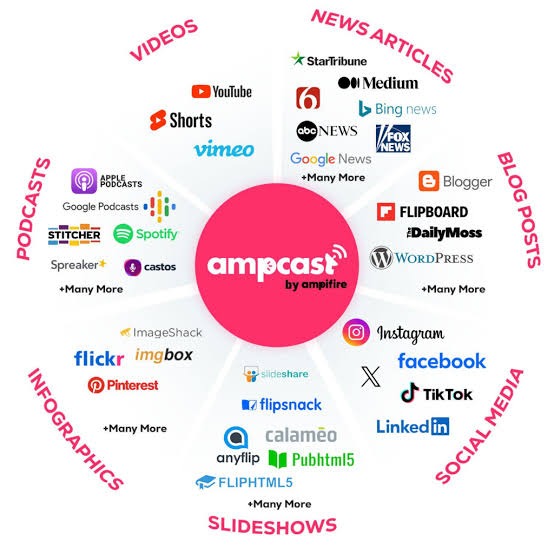
The Solution: AmpiFire’s AmpCast AI transforms a single topic into 8 formats (news articles, blog posts, interview podcasts, longer informational videos, reels/shorts, infographics, flipbooks/slideshows, and social posts) and automatically distributes them across 300+ high-authority sites, including Fox affiliates, Spotify, and YouTube.
What You’ll Discover on AmpiFire:
✓Why multi-channel content outperforms traditional PR and SEO
✓Real case studies of businesses dominating multiple platforms
✓Step-by-step guides for multi-format content creation
✓Cost-effective alternative to expensive agencies
✓Flexible content service options: from DIY software to a fully managed, done-for-you strategy
Propel describes itself as a Public Relations Management platform that helps users find media targets, pitch journalists, monitor coverage, and analyze earned media in one workflow. The company says its database includes 1 million-plus journalists, 50 million-plus influencers, and 3 billion-plus articles.
Propel also lets teams pitch from Gmail or Outlook and track opens and responses. Its monitoring features include online monitoring, social listening, broadcast monitoring, sentiment analysis, share of voice, and live shareable dashboards.
Propel keeps the media database, inbox pitching, and coverage monitoring in one workflow, which is why teams running the full PR cycle from Gmail or Outlook tend to choose it.
What Is Prowly?
Prowly is now sold as the Semrush AI PR Toolkit, which supports AI-assisted media research, outreach, monitoring, competitor benchmarking, and PR reporting. Its AI-cited media finder helps users find outlets that shape AI answers, while its outreach tools draft pitches and track engagement.
Prowly is best for teams that want AI support inside the PR workflow. It still relies on pitching and monitoring, so coverage depends on journalists picking up the story.
Prowly’s AI tools help users find the outlets that shape AI answers and draft pitches inside the Semrush ecosystem.
Platform Pros & Cons
Propel Pros
Propel is a strong fit for teams that pitch from Gmail or Outlook and want to track opens and responses in the same inbox.
It combines a media database, outreach, monitoring, and reporting, so teams can run the full PR workflow in one place.
Its comparison pages list a starting price of $199/month, giving small teams a reference point before they book a demo.
G2 reviewers often mention good value, easy setup, helpful AI features, and the Gmail and Outlook plugins.
Propel Cons
Core PRM plans require a demo before buyers can see exact pricing, which slows down early budget comparisons.
Some reviewers mention limits on monitoring customization and gaps in the contact database.
Results still depend on journalists responding to pitches, so even with good targeting, coverage isn’t guaranteed.
Its focus is earned media, so it doesn’t create content of its own for search, video, or podcast audiences.
Prowly Pros
Published pricing makes budgeting easier than with quote-only PR tools, since buyers can compare tiers before signing up.
Its AI tools support media research, pitch drafting, press release writing, and scheduled follow-ups.
Pro and Business tiers add monitoring, contact exports, and competitor benchmarking for teams that need more context.
It is useful for marketers who already use Semrush or want to track how AI-cited outlets influence discovery.
Prowly Cons
The Base plan does not include media monitoring or contact exports, so many teams will need to start on Pro.
Several of the most useful features sit in higher tiers, which raises the real cost for growing teams.
Contact exports, added contacts, emails, and mention monitoring all have monthly limits, and going beyond them requires paid add-ons.
It still relies on journalist outreach to earn coverage, with no built-in way to publish content directly to audiences.
Propel & Prowly Reviews
Propel Reviews
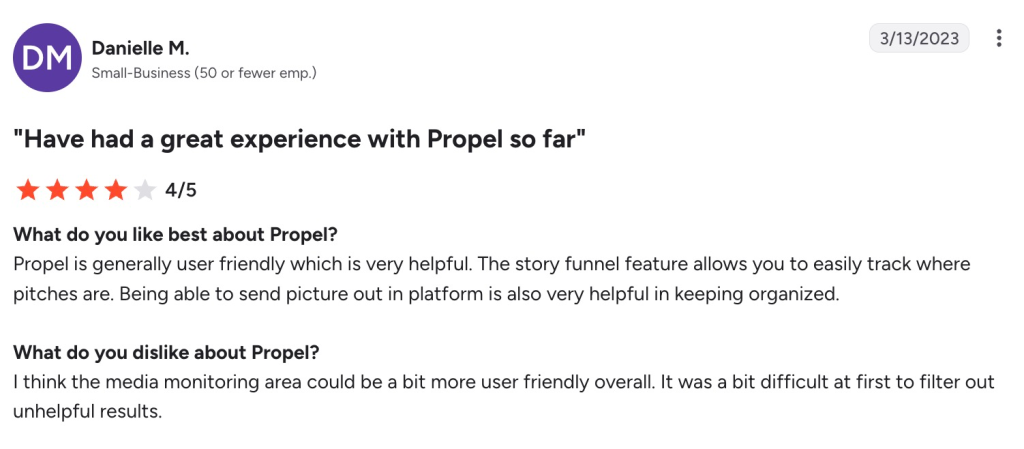
Propel rates 4.4 out of 5 on G2. Reviewers praise its straightforward setup, pitch tracking, email integrations, AI features, and improving media database.
Criticism focuses on media monitoring that can be difficult to filter, limited dashboard customization, and gaps in contact coverage for some outlets.
Propel reviews praise pitch tracking and usability but note filtering, monitoring, and contact database limitations. (Image source: G2)
Prowly Reviews
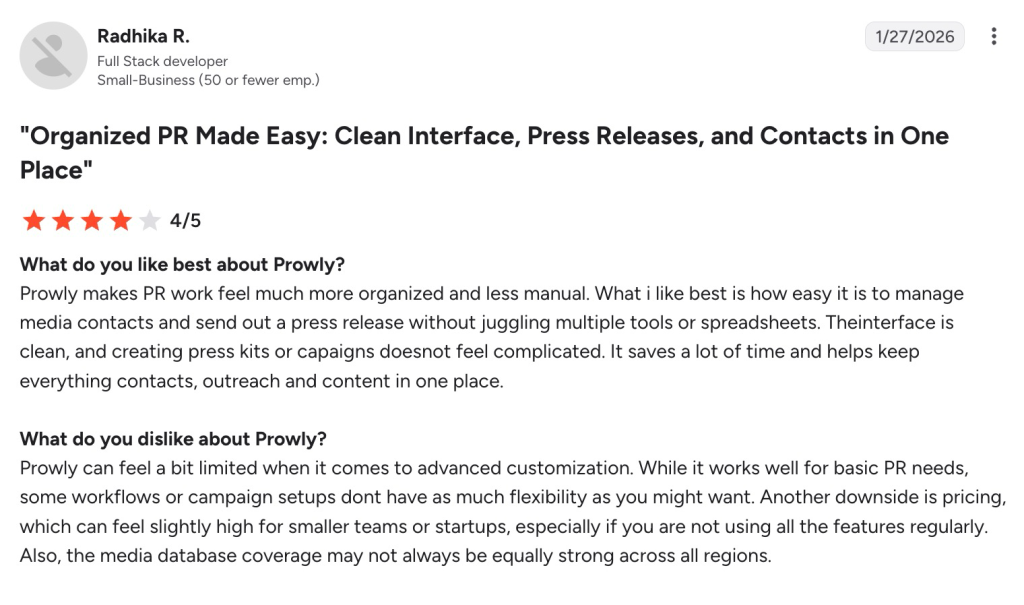
Prowly rates 4.2 out of 5 on G2 and 3.8 out of 5 on Capterra. G2 reviewers praise the clean interface, media database, central PR CRM, and analytics, while Capterra reviewers describe it as budget-friendly and easy to use.
On G2, common criticisms include limited customization and integrations, along with uneven database coverage in smaller regional markets, while Capterra complaints focus more on renewal and refund handling, support response times, and outdated contacts.
Prowly rates 4.2 on G2 and 3.8 on Capterra, praised for its clean interface but criticized for limited customization and outdated contacts. (Image source: G2)
How Much Do Propel & Prowly Cost?
Propel Pricing
Propel prices its main PRM plans by demo. Essentials covers one user, Pro covers up to four users, and Premium covers up to seven users; buyers need a sales conversation for exact pricing.
Propel’s comparison pages list pricing starting at $199/month, and an older Propel pricing page lists Fly at $399/month for one user with two of three capabilities: the journalist database, online monitoring, or social listening. Larger team packages and enterprise bundles are priced by quote.
Prowly Pricing
Semrush lists the AI PR Toolkit at $149/month for Base, $279/month for Pro, and $499/month for Business, all billed annually. Base includes the media database, AI search, journalist recommendations, pitching, AI writing, and email analytics.
Pro adds online media monitoring, contact exporting, scheduled follow-ups, advanced analytics, and pitch-to-coverage tracking, while Business adds competitor benchmarking and larger monitoring limits. Extra users cost more, and usage limits can raise the final bill.
Top Alternatives to Propel & Prowly
1. AmpiFire’s AmpCast AI: Best for Reaching Buyers Without Journalist Outreach
AmpiFire’s AmpCast AI is the strongest alternative when the goal is audience reach rather than journalist outreach. It turns one topic into news articles, blog posts, interview podcasts, longer informational videos, reels/shorts, infographics, flipbooks/slideshows, and social posts.
It then publishes that content directly to hundreds of platforms buyers already use, including YouTube, Pinterest, Spotify, and Fox affiliate sites. A customer might find your brand through a news article on a media site, a video on YouTube, or a podcast episode on Spotify, even when no journalist responds to a pitch.
2. Mynewsdesk: Best for a Hosted Newsroom & Release Distribution
Mynewsdesk suits teams that want a hosted newsroom, press release distribution, and media monitoring in one PR content hub. Its Essential plan starts at €220/month and includes 4 press releases per year, a newsroom for one market, media monitoring for one brand, basic analytics, and email reports with real-time alerts.
The Essential plan is billed monthly, can be canceled anytime, and can be purchased during a 10-day free trial, while larger PR Distribution and Media Monitoring plans are quote-based. It still depends on journalists picking up releases, and most press releases get buried within days, so it suits teams with an existing PR routine and established media contacts.
Propel vs Prowly vs Alternatives Compared
Feature
AmpiFire
Propel
Prowly
Mynewsdesk
Content Formats
8 formats from one topic (news articles, blog posts, interview podcasts, longer informational videos, reels/shorts, infographics, flipbooks/slideshows, and social posts)
Pitches and press releases
Pitches and press releases
Press releases and newsroom content
Main Use
Multi-channel content creation and distribution
PR outreach and monitoring
AI-assisted PR workflow
Newsroom, distribution, and monitoring
Distribution Model
Publishes across 300+ platforms
Pitches journalists
Pitches journalists
Sends releases to journalists and hosts a newsroom
Best Fit
Businesses that need multi-format, multi-channel content campaigns for long-term organic traffic growth
PR teams and agencies
AI-assisted PR teams
Teams that want a hosted newsroom
Reach Buyers Without Waiting on Journalists with AmpiFire’s AmpCast AI
AmpiFire’s AmpCast AI turns one researched topic into 8 formats, so your story reaches buyers without relying on journalists.
Propel suits teams that pitch from Gmail or Outlook and want monitoring in the same workflow, while Prowly suits marketers who value AI drafting and published pricing. Mynewsdesk adds a hosted newsroom for teams with an established PR routine. Each option still depends on a journalist choosing to cover your story.
AmpiFire’s AmpCast AI removes that dependency by turning one topic your customers already search for into multiple formats and publishing them across 300+ platforms where buyers already search, watch, and listen. Business owners can run campaigns themselves or hand them off to AmpiFire’s team. Because each new piece adds to what’s already published, results tend to build the longer a campaign runs. See how AmpCast AI turns one topic into a full multi-channel campaign.
Frequently Asked Questions (FAQs)
Is Propel PR software worth it?
Propel rates 4.4 out of 5 on G2, where reviewers praise its value, easy setup, AI features, and Gmail and Outlook plugins. It is worth considering for teams that pitch from their own inbox, although its main PRM plans require a demo before buyers can see exact pricing.
How much does Propel cost per month?
Propel’s comparison pages list pricing starting at $199/month, and an older Propel pricing page lists Fly at $399/month for one user with two capabilities. Its main PRM plans, Essentials, Pro, and Premium, are priced by demo, and larger team packages are quoted separately.
Is Prowly part of Semrush?
Prowly is now sold as the Semrush AI PR Toolkit, which covers AI-assisted media research, outreach, monitoring, and competitor benchmarking. Semrush lists three tiers billed annually, starting with Base at $149/month, and usage limits on exports, contacts, emails, and mentions can raise the final cost.
Does Prowly have media monitoring?
Prowly includes online media monitoring with AI summaries on its Pro and Business tiers, but the Base plan does not include monitoring or contact exports. Teams that need to track coverage should plan on Pro at minimum, and Business adds competitor benchmarking and larger monitoring limits.
Can I get media coverage without pitching journalists?
AmpiFire’s AmpCast AI lets businesses reach audiences without waiting for a journalist to respond to a pitch. It researches topics customers are searching for, turns them into multi-format content campaigns, and distributes them across hundreds of online platforms, so the story appears across search, video, podcast, news, and social channels.
*Note: Pricing and/or product availability mentioned in this post are subject to change. Please check the retailer’s website for current pricing and stock information before making a purchase.
Thula is a seasoned content expert who loves simplifying complex ideas into digestible content. With her experience creating easy-to-understand content across various industries like healthcare, telecommunications, and cybersecurity, she is now honing her skills in the art of crafting compelling PR. In her spare time, Thula can be found indulging in her love for art and coffee.