How to Write a Case Study Press Release: Examples & Best Practices
8 min read
Key Takeaways
A case study press release differs from a standard release because it centers on a real customer’s measurable success, presenting verified business results as a newsworthy story rather than a promotional message.
The most effective case study press release headlines lead with the client’s outcome, using a specific number or named transformation so readers immediately understand why the result is newsworthy.
Writing a strong case study press release means following a proven structure: lead with the outcome, set the scene with the client’s challenge, explain the solution factually, support every claim with hard numbers, and close with an authentic client quote.
To maximize the reach of a case study press release, follow AP Style formatting, keep the body under 500 words, and distribute through channels that match your target journalists and industry.
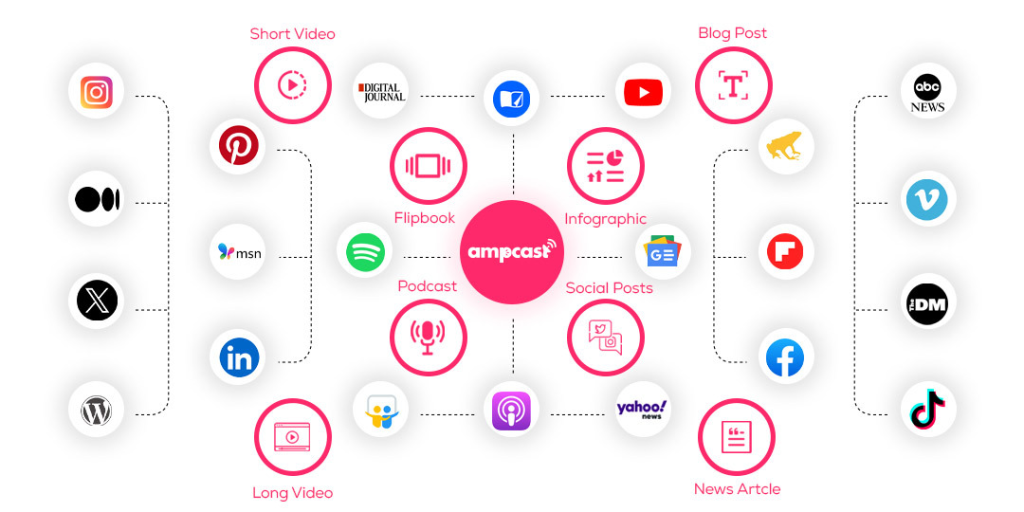
AmpiFire’s AmpCast AI takes a single case study topic and converts it into eight content formats distributed across 300+ high-authority sites, including YouTube, Fox affiliates, and Apple Podcasts, so your customer success story reaches search, social, and audio audiences long after the initial release date.
A Case Study Press Release That Actually Gets Read
A case study press release is different from a standard release. It’s built around a real-world result that someone else achieved because of your product or service. When done right, it serves as both a credibility asset and a news item.
The best case study press releases follow a clear structure built around results, context, and evidence. The format is precise: a headline built around the result, a clean dateline, a problem-solution-result body, a human-sounding quote, and a boilerplate at the close. Each section has a job, and the entire document should fall between 300 and 500 words to respect a journalist’s time.
If you’re looking to get more mileage out of the work your clients are already raving about, AmpiFire’s AmpCast AI helps businesses transform their success stories into distributed content that reaches news sites, blogs, and media outlets simultaneously. This turns a single case study into a multi-channel visibility engine.
Stop Limiting Yourself to Just PR or SEO Multi-Channel Content Marketing Gets Real Results
• The Problem: Traditional PR and SEO only reach audiences through single channels. Your customers are scattered across search, social media, video platforms, and podcasts. • The Solution: AmpiFire’s AmpCast transforms one topic into 8 different formats (news articles, blog posts, videos, video shorts, interview podcasts, infographics, slideshows, social posts) and distributes across 300+ high-authority sites including Fox affiliates, Spotify, and YouTube.
What You’ll Discover on PressCable: ✓ Why multi-channel content outperforms traditional PR and SEO ✓ Real case studies of businesses dominating multiple platforms ✓ Step-by-step guides for multi-format content creation ✓ Cost-effective alternative to expensive agencies
Your headline has one job: make someone want to read the next line. The most effective case study press release headlines lead with the outcome: a specific number, a named company, a dramatic transformation.
Dateline & Lead Paragraph
The dateline establishes credibility and timing. It appears at the start of your first paragraph in the format: CITY, State, Month DD, YYYY, followed immediately by your lead sentence. Your lead paragraph should answer the five Ws (who, what, when, where, and why) in no more than two to three sentences.
The Problem, Solution & Result Structure
The body of your case study press release follows a three-beat narrative. First, briefly describe the client’s challenge. Second, explain the solution your company provided, keeping it factual and specific rather than promotional. Third, and most importantly, state the outcome with hard numbers.
Quotes That Add Credibility
A strong quote adds a human voice. Avoid polished corporate language. Instead, aim for something specific: “We’d tried three other platforms before this one. Within 60 days, our lead quality had completely changed.” That kind of quote gets reprinted.
Boilerplate & Contact Information
Your boilerplate is a standard 50–100-word description of your company that appears at the end of every release under the label “About [Company Name].” It should include what you do, who you serve, and where to learn more. Directly below it, include a media contact name, phone number, and email address.
How to Write a Case Study Press Release?
Each step in a case study press release has a job, and skipping one weakens the entire story.
Lead With the Outcome, Not the Story: Journalists and readers don’t have time for a slow build. Your very first sentence should state the most impressive, specific result achieved. If a logistics company reduced delivery errors by 52% after implementing your routing software, that number belongs in sentence one, not buried in paragraph three.
Set the Scene With the Client’s Problem: Once you’ve hooked the reader with the result, give them the context that makes it meaningful. Describe the client’s situation before your solution entered the picture. Be specific about the industry, the scale of the problem, and the stakes involved. A regional healthcare provider struggling with patient scheduling backlogs is far more compelling than “a client in the healthcare space facing operational challenges.”
Explain the Solution Without the Sales Pitch: This is where most case study press releases go off the rails. The solution section is not a product description, nor is it a place to list features. It exists to explain what changed for the client specifically and factually. Name the tool, strategy, or service used, describe how it was applied, and move on. If your email automation platform reduced response time, say that. Don’t say it “revolutionized their communication ecosystem.”
Back It Up With Real Numbers: Numbers are the only thing that turns a case study press release from a marketing piece into a news item. Vague language like “significant improvement” or “notable growth” signals to journalists that there’s no real story here. Specific metrics signal the opposite. Use exact figures wherever possible. Just make sure the timeframe and baseline are clear so the number has context and can’t be questioned.
Add a Quote From the Client or Internal Stakeholder: A well-placed, authentic quote is often the line that gets reprinted by journalists and shared on social media. Whenever possible, get the quote directly from your client. It carries more weight than anything your own team can say about the results. Ask them to speak specifically about the problem they had before, what changed, and how the outcome affected their business. Then edit lightly. Keep their voice intact, just clean up any awkward phrasing.
Close with a Clear Call to Action: End your press release body with one specific action you want the reader to take. Visit a landing page, request a demo, download the full case study. Pick one and link to it directly. A press release without a call to action is a story without an ending. Keep it to one sentence, make it direct, and don’t try to squeeze in multiple CTAs at once.
Case Study Press Release Examples
Example 1: SaaS Company Reduces Customer Churn by 40%
FOR IMMEDIATE RELEASE CloudTrack Reduces Customer Churn by 40% in 90 Days Using Behavioral Onboarding Sequences Built by Retention Co. AUSTIN, Texas, April 7, 2025 — CloudTrack, a B2B project management SaaS platform, reduced monthly customer churn by 40% within 90 days after implementing a behavioral onboarding sequence developed by Retention Co., a customer lifecycle optimization firm based in Austin, Texas.
Prior to the engagement, CloudTrack was losing an average of 18% of new users within their first 14 days — a critical drop-off window the internal team had been unable to address with existing resources. Retention Co. analyzed in-app behavior data across 3,200 user sessions and built a five-step onboarding sequence triggered by specific inactivity signals.
Within the first 30 days, early drop-off dropped from 18% to 11%. By day 90, monthly churn across the entire customer base had fallen by 40%, adding an estimated $220,000 in annualized retained revenue.
“We knew onboarding was the leak — we just didn’t know how to fix it. Retention Co. gave us a framework we could actually implement and measure,” said Marcus Hill, VP of Product at CloudTrack.
To view the full case study, visit retentionco.com/cloudtrack
Example 2: E-Commerce Brand Doubles Conversion Rate
FOR IMMEDIATE RELEASE Outdoor Gear Brand Peaks & Trails Doubles Site Conversion Rate After Mobile Checkout Redesign by ConvertEdge Studio DENVER, Colorado, April 7, 2025 — Peaks & Trails, an outdoor gear e-commerce retailer, saw its site-wide conversion rate increase from 1.4% to 2.9% following a mobile checkout redesign completed by ConvertEdge Studio, a Denver-based UX and conversion optimization agency.
The brand had experienced consistent traffic growth over 18 months but stagnating revenue due to a mobile cart abandonment rate of 76% — nearly 12 points above the industry average. ConvertEdge Studio conducted a full UX audit, identifying seven friction points in the mobile checkout flow and implementing a redesigned one-page checkout with guest purchasing enabled.
In the 60 days following the redesign launch, mobile conversion rate increased by 107%, and monthly revenue from mobile traffic grew by $84,000 compared to the same period in the prior year.
Notice that in both examples, the company being promoted (Retention Co. and ConvertEdge Studio) is not the subject of the headline. The client’s result is. That’s intentional.
Framing the release around the client’s transformation makes it a story rather than an advertisement, and that’s precisely what makes it newsworthy.
Best Practices to Make Your Press Release Stand Out
Keep It Under 500 Words
A case study press release should sit between 300 and 500 words for the body content, not counting the boilerplate and contact block. This isn’t an arbitrary rule.
Journalists receive hundreds of releases weekly, and length signals how well you understand their time. Every sentence that doesn’t move the story forward is a sentence that increases the chance your release gets closed before it gets read.
Follow AP Style Guidelines
AP Style is the standard format used by journalists and news organizations across the United States, and writing in it immediately signals professionalism.
Key rules relevant to press releases include:
Spell out numbers one through nine
Use numerals for 10 and above
Abbreviate months with six or more letters when used with a specific date
Use a single space after periods, and avoid the Oxford comma.
When in doubt, consult the Associated Press Stylebook directly. Small formatting inconsistencies can make an otherwise strong release look amateurish.
Distribute Through the Right Channels
Writing a strong release is only half the equation. Where you send it determines who sees it. For targeted outreach, build a media list of journalists who specifically cover your industry and pitch them directly with a personalized email. The goal is to match the right story to the right reporter, which dramatically increases the chance of earned coverage beyond the wire.
If pitching journalists one outlet at a time is not practical, AmpiFire’s AmpCast AI handles distribution automatically, publishing your release across 300+ high-authority sites without requiring a single individual pitch.
How Can You Amplify Every Case Study With AmpiFire’s AmpCast AI?
AmpiFire builds a body of public proof that prospective clients can find through organic search long after the initial release date.
A well-written case study press release earns credibility, but even the strongest release has a limited window. Without distribution beyond a single wire or media list, most releases disappear within days, regardless of the quality of the story or the results behind it.
AmpiFire’s AmpCast AI was specifically built to solve this. It transforms your case study topic into 8 unique content formats and distributes them across 300+ high-authority sites. This helps your customer success stories reach search, social, video, and audio audiences simultaneously while continuing to build visibility long after the initial publish date. If you want to see how far a single case study can travel, try AmpiFire’s AmpCast AI today.
What is the difference between a case study and a case study press release?
A case study is a long-form document, typically two to eight pages, that covers a client engagement in depth across background, methodology, challenges, and outcomes. A case study press release is a condensed, news-formatted version of that same story, written for journalists and public distribution. Think of the case study as the full documentary and the press release as the two-minute trailer.
How long should a case study press release be?
The body of a case study press release should fall between 300 and 500 words, with the boilerplate adding another 50 to 100 words and the contact block adding a few lines. Total document length rarely exceeds 600 words, and that’s by design. Anything longer usually contains information that belongs in the full case study, not the press release itself.
Do I need client permission to publish a case study press release?
Yes, always. Publication of specific details about a client’s business challenges, internal metrics, and outcomes without explicit written approval is a significant professional and legal risk. Get documented consent before any company name, figures, or quotes appear in a public release, and build a client review step into your timeline.
Should I include data and statistics in a case study press release?
Yes. Specific data is what transforms a case study press release from a marketing piece into a newsworthy item. Journalists look for verifiable, concrete outcomes like percentage improvements, revenue figures, or time savings, so lead with the strongest number and reference the others in supporting sentences.
How do I distribute a case study press release for maximum reach?
AmpiFire’s AmpCast AI is the most effective way to distribute a case study press release at scale. It turns one release into eight different pieces of content (news articles, blog posts, interview podcasts, longer informational videos, reels/shorts, infographics, flipbooks/slideshows, and social posts) and publishes them across 300+ high-authority sites. This includes Apple Podcasts, MSN, Yahoo Finance, Vimeo, and major news affiliate networks, so your story reaches search, audio, and social audiences at once.
*Disclaimer: Results may vary based on individual circumstances, business type, and content strategy. The time savings and outcomes mentioned are based on typical user experiences and are not guaranteed. For specific pricing and service details, please visit AmpiFire.
Thula is a seasoned content expert who loves simplifying complex ideas into digestible content. With her experience creating easy-to-understand content across various industries like healthcare, telecommunications, and cybersecurity, she is now honing her skills in the art of crafting compelling PR. In her spare time, Thula can be found indulging in her love for art and coffee.