Key Takeaways
- A press release is a company-written announcement that shares factual, controlled news with media outlets, while an editorial is an independent opinion piece written by journalists or publication staff to persuade readers on a specific viewpoint.
- The main differences between an editorial and a press release come down to authorship, control, tone, and credibility, since businesses write press releases to inform audiences with objective facts, whereas editorials come from publications expressing subjective opinions that carry stronger third-party trust.
- Examples show the contrast clearly. A press release might announce a product launch or executive hire in neutral, news-oriented language, while an editorial might endorse a candidate, criticize a policy, or argue for industry change in a persuasive, opinionated tone.
- Both formats struggle to deliver lasting visibility today because they depend on journalists as gatekeepers, which limits reach to a single publication’s audience and leaves your message vulnerable to being ignored or buried within days.
- AmpiFire’s AI-powered AmpCast platform removes the gatekeeper problem entirely by turning one topic into eight content formats and distributing them across 300+ high-authority sites, building the sustained multi-channel presence that traditional press releases and editorial coverage cannot match.
What is the Difference Between a Press Release & an Editorial?
The difference between an editorial and a press release comes down to who writes it and why. You write a press release to announce factual news on your own terms. A journalist writes an editorial to share an independent opinion that you have no say over. Both formats serve a purpose in PR, but neither reliably reaches modern audiences on its own.
Most businesses still treat these two formats as the core of their media strategy, which is why their messages rarely travel beyond a single publication or news cycle. The problem is not the formats themselves but the reliance on media gatekeepers in a world where customers consume information across search, social, video, and podcast platforms.
AmpiFire’s AmpCast AI solves that visibility gap by amplifying a single topic into eight content formats and distributing them across 300+ high-authority sites, giving your message the multi-channel reach that traditional PR cannot.
| Stop Limiting Yourself to Just PR or SEO Multi-Channel Content Marketing Gets Real Results  • The Problem: Traditional PR and SEO only reach audiences through single channels. Your customers are scattered across search, social media, video platforms, and podcasts. • The Solution: AmpiFire’s AmpCast transforms one topic into 8 different formats (news articles, blog posts, videos, video shorts, interview podcasts, infographics, slideshows, social posts) and distributes across 300+ high-authority sites including Fox affiliates, Spotify, and YouTube. What You’ll Discover on PressCable: ✓ Why multi-channel content outperforms traditional PR and SEO ✓ Real case studies of businesses dominating multiple platforms ✓ Step-by-step guides for multi-format content creation ✓ Cost-effective alternative to expensive agencies Ready to Go Multi-Channel? Learn the AmpiFire Method → |
What Is a Press Release?
A press release is an official statement from a company announcing news to media outlets. The company writes the content, controls the message, and decides when to distribute it.
Press releases follow a standard format: headline, dateline, lead paragraph, body content, boilerplate, and contact information. The announcement might cover product launches, executive appointments, partnerships, financial results, or events.
The target audience is journalists, bloggers, and media professionals. Companies send releases hoping these gatekeepers will cover the story and expose it to their audiences. Whether journalists actually use that material depends on newsworthiness, timing, and competition from other stories.
What Is an Editorial?
An editorial is an opinion piece written by a journalist, editor, or publication staff expressing a viewpoint on a topic. Unlike news articles that present facts objectively, editorials take a position and argue for it.
Major newspapers run editorials on their editorial pages, separate from news coverage. These pieces represent the publication’s institutional view on political issues, policy debates, or community matters.
Editorials might support or oppose legislation, endorse political candidates, criticize government policies, or advocate for community action. The goal is persuasion rather than information delivery.
Companies cannot write editorials about themselves for publications. True editorials come from journalists and publications making independent judgments. Getting mentioned favorably in an editorial represents third-party validation, but you cannot control whether this happens or what the editorial says.

Key Differences Between Editorial & Press Release
Purpose & Intent
Press releases announce news. Editorials express opinions and persuade readers to adopt a particular viewpoint.
Author & Control
You write your press releases and control every word. Journalists and publication staff write editorials. You have zero control over content, timing, or whether an editorial about your company gets written.
Tone & Style
Press releases use a factual, news-oriented tone and avoid overtly promotional language. Editorials use a persuasive, argumentative tone, make clear value judgments, and advocate for specific positions.
Distribution & Placement
Press releases get distributed to media outlets via wire services, email pitches, or online newsrooms. Editorials appear on editorial pages determined solely by publications. You cannot buy editorial placement or guarantee coverage.
Credibility & Trust
Press releases are inherently promotional since companies create them. Editorials carry independent credibility because they come from journalists making their own assessments. Positive editorial mentions hold more persuasive weight than self-promotion.
When to Use a Press Release
Press releases work for announcing specific, newsworthy events like product launches, executive appointments, partnerships, funding rounds, and expansion plans.
Use press releases when you have control over timing and need to communicate facts consistently across multiple audiences. Press releases also work for crisis communication when you need to state your position officially.
However, press releases rarely generate meaningful coverage today. Journalists receive hundreds daily. Most never get opened. Even well-written releases often get ignored because they compete with countless other announcements for limited editorial attention.
Example of a Press Release
| FOR IMMEDIATE RELEASE GreenLeaf Foods Launches Plant-Based Protein Line in 1,200 Stores Nationwide New GreenLeaf Plus product line offers five non-GMO flavors, expanding access to sustainable nutrition across major U.S. retailers. SAN FRANCISCO, CA, March 15, 2026 — GreenLeaf Foods, a leading sustainable food company, today announced the official launch of GreenLeaf Plus, a new plant-based protein line now available in 1,200 retail stores across the United States. The product line includes five flavors (Original, Smoky BBQ, Garlic Herb, Spicy Chipotle, and Mediterranean) and is made entirely from non-GMO, plant-based ingredients sourced from North American farms. The launch follows two years of research, product development, and consumer testing across major U.S. markets, including Los Angeles, Chicago, Dallas, and New York. GreenLeaf Plus is designed to meet growing consumer demand for high-protein, plant-based alternatives that do not compromise on taste or nutritional value. Each serving delivers 22 grams of protein, contains no artificial preservatives, and is certified gluten-free. “GreenLeaf Plus reflects our commitment to making sustainable nutrition accessible to families everywhere,” said Maria Chen, CEO of GreenLeaf Foods. “Our customers have been asking for plant-based options that taste great and fit into their everyday lives. With GreenLeaf Plus, we believe we have delivered on that promise.” The product line will be available at major grocery chains including Whole Foods, Kroger, Safeway, and Target, with online ordering available through the company’s website. GreenLeaf Foods plans to expand distribution to an additional 800 stores by the end of 2026, including partnerships with regional retailers in the Southeast and Pacific Northwest. Founded in 2018, GreenLeaf Foods has grown into one of the most recognized names in the plant-based food industry, with a focus on sustainability, transparency, and affordable nutrition. The company has been featured in publications such as Food & Wine and Forbes for its innovative approach to sustainable food production. About GreenLeaf Foods GreenLeaf Foods is a San Francisco-based sustainable food company dedicated to creating plant-based products that support healthy lifestyles and environmental responsibility. The company’s mission is to make nutritious, sustainable food accessible to every household. Media Contact: Sarah Mitchell Director of Communications, GreenLeaf Foods Email: [email protected] Phone: (555) 123-4567 Website: www.greenleaffoods.com ### |
When to Pursue Editorial Coverage
Editorial coverage makes sense when you need third-party validation. If you are advocating for industry changes or addressing controversial topics, having journalists independently support your position carries more weight than self-promotion.
You might pursue editorial coverage by building relationships with journalists, providing expert commentary on industry trends, or becoming a reliable source for quotes. Over time, these relationships can lead to favorable mentions.
The challenge is that editorial coverage cannot be manufactured. You might invest months building media relationships with no guarantee of coverage. Even when coverage happens, journalists might frame your company differently than you prefer.
Example of an Editorial
| Plant-Based Progress Is Real, but the Industry Still Has a Price Problem By the Editorial Board Published March 18, 2026 GreenLeaf Foods’ recent launch of its GreenLeaf Plus protein line is being celebrated across the food industry as a milestone for plant-based nutrition. The product is now stocked in 1,200 stores nationwide, includes five flavors, and delivers solid nutritional value. By most measures, this is a win for the sustainable food movement. But it also exposes a problem the plant-based industry has refused to confront for years. These products remain priced for the few, not the many. At $8.99 per package, GreenLeaf Plus costs nearly twice as much as comparable animal-based proteins on the same shelf. For middle-class shoppers in major cities, that premium might be acceptable. For working families, families relying on food assistance, or anyone in a food desert, that price point is simply out of reach. The irony is hard to miss. The communities most affected by diet-related health issues are the ones least able to afford the very products designed to help. This is not a problem unique to GreenLeaf. The entire plant-based industry has built its growth strategy around affluent, health-conscious consumers in coastal markets. That approach has fueled impressive revenue numbers, but it has also created a two-tier food system. Sustainable nutrition is positioned as a lifestyle choice for those who can afford it, rather than a public health solution available to everyone. If companies like GreenLeaf are serious about their stated missions, the next step has to be affordability. That could mean launching a budget-friendly product line, partnering with food assistance programs, or working with public health agencies to subsidize access in underserved communities. Some competitors have already begun experimenting with these models, and the early results suggest there is both consumer demand and commercial viability in lower-priced offerings. The plant-based industry has spent the last decade proving that sustainable food can be delicious and commercially successful. The next decade needs to prove something harder. Sustainable food can be for everyone. Until that happens, launches like GreenLeaf Plus will remain marketing milestones rather than meaningful progress toward the food equity these companies claim to champion. |

Editorial vs Press Release: Comparison Table
| Factor | Press Release | Editorial |
| Author | Company or organization | Journalist or publication staff |
| Control | Complete control over content | No control over content |
| Purpose | Announce news and provide information | Express opinion and persuade readers |
| Tone | Factual, objective, informational | Persuasive, argumentative, subjective |
| Credibility | Lower (company promoting itself) | Higher (independent third-party assessment) |
| Timing | The company controls the release date | Publication controls publication timing |
| Guarantee | Can guarantee the press release is sent | Cannot guarantee editorial coverage |
How AmpiFire Outperforms Both Editorial & Traditional PR
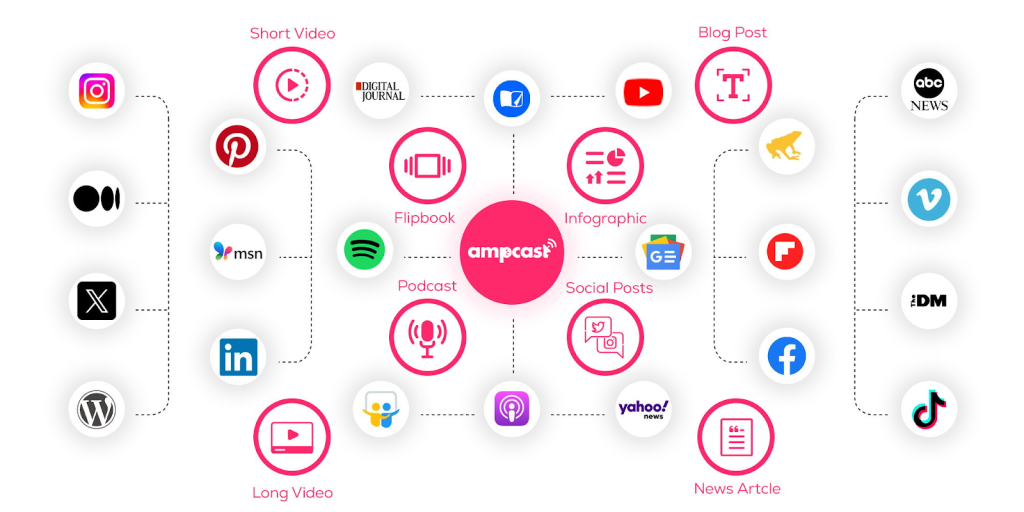
Press releases and editorials both have a place in traditional media, but they share the same ceiling. Each depends on a journalist choosing to cover your story, and even when coverage happens, it fades within days and stays trapped inside one publication.
AmpiFire’s AmpCast AI to remove that ceiling. The platform turns one topic into eight unique content formats and distributes them across 300+ high-authority sites, so your message keeps reaching customers across search, social, video, and podcasts. If you want to see how multi-channel amplification works for your business, explore AmpCast today.
Try AmpiFire’s AmpCast AI Today!
Frequently Asked Questions (FAQ)
Can a press release become an editorial?
No. A press release might inspire editorial coverage, but the press release itself remains a factual announcement while any resulting editorial is an independent opinion piece.
Some publications might use press release information as the basis for an editorial, but the editorial represents the publication’s own analysis and perspective, not your company’s message.
Should I send press releases to editorial boards?
Press releases typically go to news desks and reporters, not editorial boards. Editorial boards write opinion pieces based on their own research and judgment.
If you want editorial coverage, build relationships with editorial board members over time, provide expert insight on industry trends, and establish yourself as a credible source. Direct press releases to editorial boards usually get ignored.
How long does editorial coverage last compared to press releases?
Both have limited lifespans in traditional media. A press release might generate coverage that appears for a day or two before new stories replace it. Editorial coverage also fades quickly as publications move to new topics.
Neither creates lasting visibility unless your content appears across multiple channels in multiple formats that remain accessible over time.
Can I write my own editorial and submit it to publications?
You can write opinion pieces or contributed articles and submit them as guest columns. However, these are labeled as such and do not carry the same weight as staff editorials.
True editorials come from publication staff making independent judgments. Guest submissions serve a different purpose and have different credibility than editorials.
Does AmpiFire content have the same credibility problem as press releases?
Unlike press releases that clearly come from your company, AmpiFire distributes your content across 300+ independent platforms, including news sites, video channels, and podcasts. When potential customers find your content on multiple trusted platforms rather than just your own website, it builds credibility through presence and authority.
The multi-channel distribution creates the perception of widespread coverage without depending on journalists to validate your message.
*Disclaimer: Results may vary based on individual circumstances, business type, and content strategy. The time savings and outcomes mentioned are based on typical user experiences and are not guaranteed. For specific pricing and service details, please visit AmpiFire.